A World Without the Post Office

usps

Share this infographic on your site!

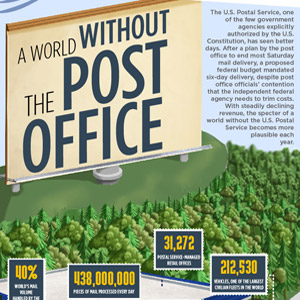
A World Without the Post Office

The U.S. Postal Service, one of the few government agencies explicitly authorized by the U.S.
Constitution, has seen better days. After a plan by the post office to end most Saturday mail delivery,
a proposed federal budget mandated six-day delivery, despite post office officials’ contention that the
independent federal agency needs to trim costs. With steadily declining revenue, the specter of a world
without the U.S. Postal Service becomes more plausible each year.

The Size and Reach of the Post Office:

31,272

Postal Service-managed retail offices

212,530

Vehicles, one of the largest civilian fleets in the world

1.3 billion

Miles driven each year by letter carriers and truck drivers

40%

World’s mail volume handled by the Postal Service

8 million

Employees

438,000,000

Pieces of mail processed every day

$65 billion

2012 revenue

$1.8 billion

Salaries and benefits paid every two weeks

423 million

Annual visits to usps.com

5.7 million

Passport applications accepted every year

0

Tax dollars received for operations

152 million

Total delivery points

Blame It on Gmail? Mail Volume Falls

With easy, free access to email, and thus email marketing, the demand for mail has fallen over the past
decade.

2 in 3

Americans have access to email; that is expected to rise to 72% by 2017

More Than Mail: Our Love Affair With Stamps

The fare for sending a letter—the stamp—is a huge part of U.S. culture. We celebrate with holiday-
themed stamps; we raise money with charity stamps; and we collect old stamps, well, because they’re
cool.

Charity

Stamps sold slightly above the cost of a regular stamp, semi-postal stamps raise funds for causes
identified by Congress.

Commemorative Stamps

The post office has released dozens of commemorative stamps over the years, whether related to
music, entertainment or Americana. Here are the most collected commemorative stamps.

SOURCES:

U.S. Postal Service

findyourstampsvalue.com

eMarketer

usps-thumb

Getting Value for Your Money — And Why It Matters

Losing_Money

We all want a good deal, and we feel bad when we don’t get one, especially if we learn later that we could have gotten something much cheaper than what we actually paid for it. In that case, we feel ripped off — that we’ve lost something.

Most of us don’t have a lot of excess cash. If we don’t use it wisely by getting good deals, we can quickly get into unmanageable debt, which, if it doesn’t lead to a serious crisis such as foreclosure of one’s home, can lead to a more gradual pressure on our lives in which our resources and energies get stripped into the servicing of debt. This can become a prisoner’s existence, with debts the shackles.

So let’s say that in your personal life you are being responsible, living within your means, not paying more for things than you should, and not taking on more expenditures than you should. Let’s also say that you are giving people good value for your services, not gaming the system, creating value, so that your gain is not another’s loss. In that case, it becomes disheartening to realize that much of your money is still not being used responsibly — not by you but by government and others (usually empowered by government) to skim off your cash with the full consent of the law.  [Read more...]

Decoys, Neuromarketing, and Behavioral Economics

neuro-marketing

Richard Feynman, one of the best mathematical physicists of the last century, thought that a particularly important virtue of scientists was not to fool people. To this Feynman, with his keen sense of irony, added that the easiest person to fool is oneself. Feynman, here, was speaking to the confirmation bias that infects so much of human inquiry. In this we tend to find and justify the very things we most wish are true — even if they’re false.

One of the things we most wish to be true is to get a good deal. Whenever we’re putting money toward anything, be it shopping at the local mall or investing money in financial instruments, we want to make sure we’re getting the best deal possible. In particular, it grieves us if we find out later that we could have gotten the same product with substantially less money than we put toward it.

daniel_kahnemanHumans hate loss more than they enjoy comparable gain. This, and many other findings in the emerging field of behavioral economics, are shedding interesting light on our proclivities as buyers as well as on how to exploit those proclivities. Behavioral economics arose in the last 40 years, starting with the work of cognitive psychologists Amos Tversky and Daniel Kahneman. They found that humans, far from behaving as maximizers of utility, often violate this principle, doing things that are predictable and yet irrational in terms of conventional economic theory.

Dan_ArielyOne of the leading lights in this field is Dan Ariely, a behavioral economist on the faculty at Duke (he’s teaching a free online course on behavioral economics at Coursera beginning March 25, 2013). His book Predictably Irrational provides a good overview of the field for a lay audience. Many themes emerge from this work. Thus, and as we’ve seen, people intensely dislike losing things that they once possessed. Also, they really really like it when things are free. For instance, imposing even the slightest cost on a service drastically reduces people’s use of it. That’s why Amazon.com has FREE SHIPPING. It’s really not free, the cost getting factored in elsewhere, but it makes an enormous different to how free people feel about ordering from Amazon when the shipping is, ostensibly, free.

Behavioral economics is a vast subject and we’ll only touch on it here. But in touching on it, let’s focus on a place where it can be abused. People behave irrationally in predictable ways. The irrationality here is gauged in terms of people’s stated self-interest. Self-interest says that we should strive for this and avoid that. And yet, by manipulating people’s perceptions, it’s possible to get people to act against their self-interest and in the interests of the manipulator, that is, the person who understands behavioral economics and is able to exploit it against people.

Consider the use of decoys in marketing. People don’t like to buy something if it’s the only one of a kind on the market. It just doesn’t feel right. If there’s only one, how can it be any good? This happened with bread machines a few decades ago. Someone had the bright idea of making machines dedicated exclusively to making bread. But initially the idea didn’t take off — not many people were buying the machines. Until, that is, a marketer who knew something of behavioral economics (whether under that rubric or self-taught) that the way to sell these machines was to market a second machine. By producing two machines and making one clearly a better deal than the other, the manufacturer wasted and made no profit on one of the machines, but recouped the loss on the other, which then were selling like hot cakes.

This is how decoys work. They form a prime example of that subdiscipline of behavioral economics known as neuromarketing. Decoys allow for a comparison between the decoy and the target brand. Manufacturers lose money on the decoy, but they make it back by the extra sales that the decoy drives to the target brand. To make the target brand obviously better than the decoy, the target will be cheaper and of better quality than the decoy. Who in his/her right mind would buy the decoy? But that’s not the point. The point is that by drawing a comparison with the target and putting it in a better light, massively increased sales of the target can be generated.

We see a variation of this when the Wall Street Journal sells a hardcopy subscription for MORE than a combination of hardcopy and online access. Who in his/her right mind would not take both the hardcopy and the online access over mere hardcopy, especially when the combination is cheaper? But doing so drives sales to the item the Wall Street Journal really wants to sell, namely, the combination, which allows for users also to be hit with online advertising.

Is there anything morally wrong with such decoys? Yes and no. Obviously there is no physical coercion here. People are free to buy what they want and don’t have to buy anything at all. And yet, there is clearly some manipulation going on here. We are being manipulated and we’re not being told that we’re being manipulated. WARNING: THIS IS A DECOY BRAND; YOU ARE PROBABLY BUYING THIS BRAND BECAUSE THE MANUFACTURER IS ALSO MARKETING AN INFERIOR BRAND AT A HIGHER PRICE. Such warnings exist on no products. Yet the truth is that some products are marketed in precisely this way.

Decoys of this sort are part of a wider move by behavioral economists to shape our environments to get us to do not what we consciously think is in our best interest but to get us to do unconsciously what others, the powers that be, regard as in our best interest. Take Richard Thaler and Cass Sunstein’s Nudge: Improving Decisions about Health, Wealth, and Happiness. In this book they describe how the environment may be shaped to give people all the options they’ve previously had, and yet in ways that radically changes people’s behavior. For instance, in a cafeteria, if you want kids to eat more salads and less sweets, put the salads front and center and make the sweets hard to find.

Thaler and Sunstein call this approach “libertarian paternalism.” Paternalism always indicates that someone else knows what’s better for you than you do yourself. The adjective libertarian in front of paternalism indicates that the paternalism is exercised in a non-coercive rather than coercive form. But paternalism is paternalism. It suggests that we’re too stupid to know what’s best for us, or that even if we know better, we lack the self-control to do the right thing. Now that may be, but should we be manipulated into doing what’s right?

Or would it be better, whenever behavioral economists try to manipulate our actions, that we be informed that this is exactly what they are doing? Should truth in advertising include how behavioral economists are influencing our actions and decision making? In an age of over-regulation, that’s perhaps asking for too much. Perhaps a Ralph Nader of behavioral economics will arise who will call manipulative behavioral economists on the carpet as a public service whenever they try to put one over on the rest of us.

Behavioral economics points up that humans have an irrational side. But the fact that we have a rational side that can reflect on our irrational side and appreciate when we are being had suggests that behavioral economics is best played with cards on the table. People don’t like being manipulated, even for their supposed benefit. If behavioral economists want to maintain good will for their discipline and long-term influence, it is probably in their interest to be completely up front with what they’re doing. They might therefore want to explan their “libertarian paternalism” to an “open source libertarian paternalism,” which in line with the open source movement in computer software hides nothing about what it is doing.

Interestingly, behavioral economics tends to work even when people know that it is being used on them. For instance, contrary to popular conception, recent research has shown that placebos work even people know that they are placebos (ref). So being up front about its use is probably not going to limit its effectiveness. But it can prevent behavioral economics from getting a bad name as people resent its intrusion without their knowledge.

Vaccines and Autism — What Might the Numbers Be Saying?

While autism rates in the United States have exploded over the last 50 years, autism’s prevalence is still small enough that in most nuclear families children are not affected by this disorder. Still, the prevalence is now sufficiently high that most people know some family affected by this disorder. This was not the even case 20 years ago.

Is it fair to say that autism rates have in fact “exploded”? Look at the table featured at the start of this piece,[1] and you’ll see that autism rates have about doubled in the 8 years from 2000 to 2008. Moreover, they’ve gone up over 20-fold since the 1960s.[2] Here’s a brief summary of autism rates in the U.S. over the last fifty years:

  • 113 per 10,000 in 2008
  • 67 per 10,000 in 2000
  • 35 per 10,000 in the mid 1990s
  • 10 per 10,000 in the 1980s
  • 5 per 10,000 in the 1960s and 1970s [Read more...]

What are you going to believe, me or the numbers?

In the classic Marx Brothers comedy DUCK SOUP, Groucho finds Chico with Groucho’s girlfriend in a bedroom. Chico tries to deny any hanky-panky by asking “What are you going to believe, me or your own eyes?”

Obviously, Groucho should believe his own eyes and not Chico’s baldfaced lies. And yet, in many circumstances of life, we tend to believe not our eyes but what we wish to be true based on our own predilections and pet ideologies.

Economics, for instance, is a field rife with ideology. As an academic discipline, economics can afford to consider different approaches and make different presuppositions about how best to run an economy.

But when it comes to economic policy that will impact people across the society, it’s best to knock ideology down a few notches and try to assess, in as accurate numerical terms as possible, what the practical outworkings of a policy are really going to be.

Or course, this can be easier said than done. With a policy, it’s possible to measure its consequences as they unfurl over time. But it’s much more difficult to forecast accurately what’s going to happen down the pike. And it’s even more difficult to assess counterfactuals such as what would have happened had a different policy been put into effect.  [Read more...]

Hurricane Sandy, Rising Oceans, and Global Warming — What Are the Numbers Really Saying?

Debates in our culture are increasingly polarized. This is especially evident in the debate over global warming. Thus, those who think man-made or anthropogenic global warming is real and destructive take one side. On the other side are the global warming skeptics, who think that humanity’s contribution to global warming is negligible and that our efforts for improving the planet are best channeled in other directions.

In all such discussions a moral element looms large. Those who think man-made global warming is real and bad think it is very bad indeed and that those who are skeptical of it have no love for the planet, making them not just mistaken in their understanding of climate science but also bad people. On the flip side, those who are skeptical of humanity’s role in global warming tend to view their opposites as fanatics and opportunists seeking some place to invest their moral energies and going on a power trip in which they become the saviors of humanity by turning back the dreaded scourge of man-made global warming.

In such sharply polarized situations, two sides typically speak past each other, with no real meeting of minds. For people who want clarity in the matter, it would therefore be helpful to chart some third position that attempts to see things dispassionately. Looking at the actual numbers connected with the global warming debate is perhaps the safest and cleanest way to do this. Thus, in place of global warming advocates and global warming skeptics, perhaps a third group can take the stage, namely, global warming analysts (there may be better ways of describing this group, but let’s go with this for now).

Instead of getting into it over the presumed negative consequences of global warming or the presumed negative consequences of taking political action to counter global warming, the global warming analyst asks the hard number questions that get to the heart of any claim about global warming that is being made. Numbers are always at the heart of this debate, and calculating them can provide clarity and insight without fanning the moral outrage that constantly infects this debate.

Take Hurricane Sandy, which in the last days has devastated the East Coast of the United States. Yesterday evening (30Oct2012), onMSNBC’s Hardball, Chris Matthews interviewed Princeton University professor Michael Oppenheimer, who has joint appointments in geosciences and politics (such joint appointments themselves underscore the politicization of the global warming debate). In the interview, Oppenheimer made the point that sea levels have been rising on account of global warming and that this made the devastation to New York City worse than it would otherwise have been. Chris Matthews accepted this claim by Oppenheimer and moved on.  [Read more...]

The Amazing History of Information Storage: How Small Has Become Beautiful

People have been storing information since the stone ages, ever since they’ve been writing or putting art on tablets and walls. With the invention of paper and ink, the “density of information” increased significantly, packing a lot more information into a tighter space (such scrolls and eventually bound books, as we still use today).

The invention of printing didn’t substantially increase the density of information, though it greatly contributed to its dissemination by making information easier to copy. In the 20th century, the benchmark for a sizable chunk of information became the Encyclopedia Britannica.

The 2010 edition (the last print-edition that Encyclopedia Britannica will ever publish) consists of 32 volumes and weighs 129 pounds. (Source) At 50 million words or about 300 million characters, it requires roughly gigabyte to store the text electronically (leaving out images and diagrams).

In an age of thumb drives that weigh less than an ounce and that, these days, routinely hold 8 or 16 gigabytes, paper and ink doesn’t seem like a very efficient way to store information. But electronic storage wasn’t always so efficient.

Have a look at the following picture, taken in 1956. What is being taken out of that old Pan Am airliner?

What you see here is the hard drive for IBM’s 305 RAMAC computer. That hard drive, weighing over 2,000 pounds, stored a whopping 5 megabytes (not gigabytes!). It would take 200 of these to store the Encyclopedia Britannica.

The 350 Disk File consisted of a stack of fifty 24-inch discs… The capacity of the entire disk file was 5 million 7-bit characters, which works out to about 4.4 megabytes in modern parlance. This is about the same capacity as the first personal computer hard drives that appeared in the early 1980s, but was an enormous capacity for 1956. IBM leased the 350 Disk File for a $35,000 annual fee. (Source)

Note that this hard drive cost $35,000 in 1956 dollars not to buy but to rent. According to the consumer price index, $35,000 back then was worth more than $295,000 in 2012 buying power.

Of course, Moore’s law, which says that computational power doubles every 18 months, guaranteed that both cost and information density would come tumbling down. By 1980, a five megabyte Seagate hard drive could sit comfortably on your desktop and cost you only $5,000 (that is, $12,600 in 2012 buying power). A 1 gigabyte hard drive in 1980 weighed 500 pounds. (Source)

By 1987, your standard Macintosh computer was coming with 20 megabytes of storage. By 1990, you could, for a few hundred dollars, swap out those 20 megabytes for a then “large” 100 megabyte hard drive. And by 1996, Macs were coming with a one or two gigabytes of storage.

So, by 1996, the standard hard drives of desktop computers could finally hold the full Encyclopedia Britannica.

Information on hard drives is stored on a two-dimensional surface, so it makes sense to ask how many bits or bytes are stored per square inch, centimeter, or any other unit of length.

The information density of IBM’s 305 RAMAC came to 250 bytes per square inch. Compact disks (or CDs), which have been popular since the 1980s and are also a two-dimensional storage medium, have an information density of about 1 gigabyte per square inch.

This level of density for CDs may see a bit generous given that a standard CD is over 4 inches in diameter and contains less than a gigabyte of information. But the tracks on a CD are about three times as far apart as the width of a track (the pits that make up a track are about half a micrometer in width), so this measure of CD information density omits a lot of the unused space on the CD.

DVDs, by using smaller pits and tighter packing of tracks, have an information density of slightly more than 2 gigabytes per square inch. And Blu-ray can take information density up to 12 gigabytes per square inch.

Commercial hard drives have increased their information density well beyond this, and are now in the several 100s of gigabytes per square inch.

Flash memory, because it’s solid state and allows the possibility of 3-D stacking, has an information density measured in nanometers. Logic gates that store information for flash memory are now around 20 nanometers (recall that the pits that store the memory in a CD are .5 micrometers in width, or 500 nanometers).

While all this increase in density of information storage for commercially available devices is impressive, we can do much better. For instance, cellular life has developed highly dense information storage. The DNA inside any human consists of roughly 1 gigabyte of information (3 billion nucleotide base pairs, so this is the right order of magnitude).

The DNA double-helix is 2 nanometers in diameter and rises 3.4 nanometers at each winding, also adding roughly 10 nucleotides at each winding. Do the math, and one finds that DNA stores information at a density of about 10^18, or a billion billion, bytes per cubic millimeter (i.e., 1 exabyte per mm^3). Because 1 inch is 25.4 millimeters, that’s a density of roughly 10^22, or ten billion trillion, bytes per cubic millimeter (i.e., 10 zettabytes per mm^3).

Commercial electronic devices therefore don’t even come close to the information storage in the DNA of biological systems. A 1 gigabyte memory component of thumb drive made out of not flash but DNA memory would only need a diameter of 10 micrometers (human hair is between 17 and 180 micrometers in diameter; 1000 micrometers make a millimeter). The DNA from every species that has ever existed over the billions of years of evolution could be fit into a teaspoon.

As impressive as the information density of DNA is, physics allows for information storage at a much greater density still. DNA is a complex molecule and even the nucleotide bases that store genetic information are reasonably complex molecules, composed of numerous atoms. DNA therefore requires numerous atoms for each byte of information it stores.

But it is also possible to store information at the atomic level. Using dipolar coupled spins for quantum memory storage, researchers have been able to store 1,024 bits of data on a single 5CB (C18 H 19 N) molecule, which is roughly 27 bits per atom or slightly over 3 bytes per atom. That’s a significantly higher density of information storage than found in DNA. (Source)

But scientists have done even better than this. In 1959, physicist Richard Feynman offered a $1,000 prize for anyone who could shrink a page to 1/25,000 its size. Since a page is two dimensional, such a shrinkage would constitute an information density reduction by a factor of over 600 million, and could write the Encyclopedia Britannica on the head of a pin.

Not until 1985 did Feynman finally have to pay out his prize money. It went to researchers at Stanford who used “electron beam lithography to engrave the opening page of Dickens’A Tale of Two Citiesin such small print that it could be read only with an electron microscope.” (Source)

This record held until 1990, when researchers at IBM arranged 35 xenon atoms to form the IBM logo.

Finally, in 2009, researchers, back at Stanford, where able to improve on IBM’s miniaturization, making it 40 times smaller. Using electronic quantum holography, they were able to store

35 bits per electron to encode each letter [and] write the letters so small that the bits that comprise them are subatomic in size. So one bit per atom is no longer the limit for information density. There’s a grand new horizon below that, in the subatomic regime. Indeed, there’s even more room at the bottom than we ever imagined. (Source)

To sum up, in 1956, a 5-megabyte IBM hard drive weighed over a ton, or roughly 1,000 kilograms. In other words, that hard drive stored information at a density of 5 bytes per gram.

In 2009, Stanford researchers were able to store information at a density of 35 bits per electron, or roughly 4 bytes per electron. Since an electron weighs roughly 1 in 10^27 grams (i.e., one part in a thousand trillion trillion grams), that means the ultimate information density discovered to date weighs in (literally) at four thousand trillion trillion bytes, or 4 brontobytes (see appendix), per gram.

That makes our commercially available terabyte and petabyte storage devices seem crude.

APPENDIX: Disk Storage Reference

· 1 Bit = Binary Digit
· 8 Bits = 1 Byte
· 1000 Bytes = 1 Kilobyte= 10^3 Bytes
· 1000 Kilobytes = 1 Megabyte= 10^6 Bytes
· 1000 Megabytes = 1 Gigabyte= 10^9 Bytes
· 1000 Gigabytes = 1 Terabyte= 10^12 Bytes
· 1000 Terabytes = 1 Petabyte= 10^15 Bytes
· 1000 Petabytes = 1 Exabyte= 10^18 Bytes
· 1000 Exabytes = 1 Zettabyte= 10^21 Bytes
· 1000 Zettabytes = 1 Yottabyte= 10^24 Bytes
· 1000 Yottabytes = 1 Brontobyte= 10^27 Bytes
· 1000 Brontobytes = 1 Geopbyte= 10^30 Bytes

Goedel’s Theorem for Dummies

When people refer to “Goedel’s Theorem” (singular, not plural), they mean the incompleteness theorem that he proved and published in 1931. Kurt Goedel, the Austrian mathematician, actually proved quite a few other theorems, including a completeness theorem for first-order logic. But the incompleteness theorem is the one for which he is most famous.

To get some sense of the impact of Goedel’s Theorem on the mathematical community, consider how Herman Weyl, perhaps the greatest mathematician of the first half of the twentieth century, reacted to it. According to Weyl, up until Goedel’s Theorem, mathematicians were optimistic that all questions in mathematics could be definitively answered either one way or another (see his contribution to Oldenbourg’s Handbook of Philosophy).

[Read more...]

The Mathematics of Hell

(Or Jonathan Edwards Meets Leonhard Euler)

Visions of hell abound, not just in Christian literature but also in mythology. The Greeks, for instance, had Sisyphus, who was condemned to an eternity of futility, constantly rolling a rock up a hill, only to have it come tumbling back once he was almost at the crest. Or consider Tantalus, who was condemned to viewing all sort of sensuous delights, only to have them fall out of reach as soon as he tried to grasp them.

While religious and mythological imaginations are quite respectable at depicting the horrors of hell, one may ask what a mathematician might do if asked to design hell. Here’s one possibility. In the theory of infinite sequences, some sequences converge to a fixed number and others go off to infinity. Thus, for instance, the sequence 1, 2, 4, 8, 16, etc., where the general term is 2^n, goes off to infinity whereas 1, 1/2, 1/3, 1/4, 1/5, etc., where the general term is 1/n, converges to 0.

Now, some numbers go off to infinity much faster than others. The sequence 1, 2, 4, 8, 16, etc. with general term 2^n has an exponential rate of growth and thus goes off to infinity pretty fast. But mathematicians can think up much faster rates of growth. Consider, for instance, the number m! (i.e., “m factorial”), which equals 1 x 2 x 3 x … x m, and now define the superfactorial m!!n recursively as m! for n = 1, (m!)! for n = 2, and in general (m!!(n-1))!. Basically, m!!n means take m and apply the factorial operator to it n times. Hence SUPERfactorial.

If we now compare 2^n with n!!n, we find that n!!n goes to infinity much much faster than 2^n, in fact so much so that if we divide out n!!n by 2^n, the sequence n!!n/2^n still goes off to infinity. Granted 1!!1 is just 1 and 2!!2 is just 2, but 3!!3 is a 1,747-digit number: 3!!! = 6!! = 720! =

2601218943565795100204903227081043611191521875016945785727541837850835
6311569473822406785779581304570826199205758922472595366415651620520158
7379198458774083252910524469038881188412376434119195104550534665861624
3271940197113909845536727278537099345629855586719369774070003700430783
7589974206767840169672078462806292290321071616698672605489884455142571
9398549944893959449606404513236214026598619307324936977047760606768067
0176491669403034819961881455625195592566918830825514942947596537274845
6246288242345265977897377408964665539924359287862125159674832209760295
0569669992728467056374713753301924831358707612541268341586012944756601
1455420749589952563543068288634631084965650682771552996256790845235702
5521862223581300167008345234432368219357931847019565107297818043541738
9056072742804858399591972902172661229129842051606757903623233769945396
4191475175567557695392233803056825308599977441675784352815913461340394
6049012695420288383471013637338244845066600933484844407119312925376946
5735433737572477223018153403264717753198453734147867432704845798378661
8703257405938924215709695994630557521063203263493209220738320923356309
9232675044017017605720260108292880423356066430898887102973807975780130
5604957634283868305719066220529117482251053669775660302957404338798347
1518552602805333866357139101046336419769097397432285994219837046979109
9563033896046758898657957111765666700391567481531159439800436253993997
3120306649060132531130471902889849185620376666916446879112524919375442
5845895000311561682974304641142538074897281723375955380661719801404677
9356147936352662656833395097600000000000000000000000000000000000000000
0000000000000000000000000000000000000000000000000000000000000000000000
0000000000000000000000000000000000000000000000000000000000000000000

With this bit of background, we can now describe how a mathematician might design hell. At even intervals n = 0, 2, 4, 6, etc., provide a brief respite from torment. In fact, provide sheer delight during those intervals, but do so for only 1/n seconds. At odd intervals n = 1, 3, 5, 7, etc., provide n!!n seconds of torment, and let the intensity of torment double at each second of the interval. So, for the 1,747-digit number of seconds making up interval 3, if the intensity of torment is some value during a given second (let’s set the initial level of torment at passing a large kidney stone), then it doubles each subsequent second thereafter for all the seconds comprising this 1,747-digit number.

Interestingly, the total number of moments of torment and delight in this design of hell will be the same because the harmonic series 1 + 1/2 + 1/3 + 1/4 + etc. goes to infinity (check your basic calculus text if you doubt this) and, of course, the superfactorial series 1!!1 + 2!!2 + 3!!3 + etc. also goes to infinity. So, stretched to eternity, this scenario provides as much torment as delight. Only because of the timing in the way the torment and delight are experienced will the torment seem to totally dominate and outweigh the delight.

You might wonder why put in the delight at all. It turns out, as a matter of human psychology, it actually makes a painful task all the more painful if it is interspersed with a little pleasure rather than just getting it all out of the way at once. The ever briefer moments of delight, interspersed among oceans of pain, will highlight the pain and make the torments of hell all the more poignant. Indeed, the moment of delight call to mind all the pleasures that were missed by being consigned to (the mathematician’s) hell.

The mathematics here is completely elementary and could easily have been conveyed by mathematician Leonhard Euler (1707-1783) to theologian Jonathan Edward (1703-1758), who is best remembered for his sermon “Sinners in the Hands of an Angry God.” (Go here for the sermon and here for a rationalization of why one should not be utterly appalled at it.) In that sermon, Edwards writes:

The God that holds you over the pit of hell, much as one holds a spider, or some loathsome insect, over the fire, abhors you, and is dreadfully provoked; his wrath towards you burns like fire; he looks upon you as worthy of nothing else, but to be cast into the fire; he is of purer eyes than to bear to have you in his sight; you are ten thousand times so abominable in his eyes as the most hateful venomous serpent is in ours. You have offended him infinitely more than ever a stubborn rebel did his prince.

With the help of some basic mathematics, Edwards may have fleshed out his picture of hell along the lines sketched here.

Potential Infinity vs. Actual Infinity

What is infinity and does it even exist? In our everyday experience, we find only finite things. A basket of eggs contains only a fixed number of eggs and no more. Our bodies are composed of particles (molecules, atoms, protons, quarks, etc.). But whatever particles describe our make up, we find only a finite number. It may be billions or trillions or more, but it still doesn’t get close to infinity. Even the known universe is finite – it’s only so many light-years in diameter and contains only so many elementary particles.

How, then, does one even get close to infinity? People have long realized that there’s no biggest number because it’s always possible to add 1 to any number and get still a bigger number. So numbers themselves, taken collectively, are infinite. Any given number is finite, but the mere fact that numbers go on forever – that’s infinite.

But what sort of infinite is this? The ancient Greek philosopher Aristotle (384– 322 BC) proposed that there are two types of infinity, a potential and an actual infinity. In a potential infinity, one can keep adding or subdividing without end, but one never actually reaches infinity. In a sense, a potential infinity is an endless process that at any point along the way is finite. By contrast, in an actual infinity, the infinite is viewed as a completed totality. Aristotle rejected actual infinity, claiming that only potential infinity exists.

So what, you say? For all practical purposes, we get on quite well with quite a bit less than even a potential infinity. Take the world’s most powerful supercomputer, Japan’s K Computer, which runs at 10 petaflops, using 705,024 SPARC64 processing cores. There are absolute limits to what this machine can do in terms of storage, retrieval, and processing. It’s safe to say that 10^100 (i.e., the number 1 followed by 100 zeros, aka “google”) sets an absolute limit on the amount of processing steps this machine will ever do, on the length of the longest number it can compute, and on the amount of bytes available to the machine’s memory.

And yet, the infinite is not so readily cast aside for practical reasons. Modern mathematics is done almost entirely in terms of sets (recall the “New Math”). Set theory treats just about anything as a set (the only things that are not sets are things too big to be sets – more on that in another post). Now numbers are sets. For instance, 0 is the empty set (it contains zero items). The number 1 is also a set (it is the set that contains zero, and thus is a set with one item).

But all the numbers taken collectively (0, 1, 2, etc.) also form a set, known to mathematicians as the natural numbers and represented as {0,1,2,3,…}. Ah, but what’s that ellipsis, those three dots (i.e., …), doing there? Doesn’t that tell us that the natural numbers are really just a potential infinity? Mathematicians don’t treat the natural numbers as a potential infinity but as an actual infinity – a completed totality that includes all numbers 0, 1, 2, etc.

But what do mathematicians know anyway? Perhaps treating the natural numbers as an actual infinity is just a convenient way to think about numbers and do calculations. If people’s concerns about infinity were left simply at the level of mathematics and its scientific applications, the debate over potential and actual infinities would be moot. But it turns out that this debate spills over into other areas, notably theology. If God is real, is he an actual infinite or is he just a potential infinite? Most religious believers see God also as unchanging, so if God is real and infinite, he must be an actual infinity.

Now it’s interesting that Georg Cantor, who invented set theory over 100 years ago, did so in part for theological reasons, seeing the infinite sets he came up with as a reflection of the infinity of God. Others, however, not believing that God exists or thinking that the very concept of an actual infinity is incoherent, reject the actual infinity and thus view Cantor’s so-called actual infinities as simply a device for describing much more mundane and finite processes. Yet it is a device that every working mathematician uses. As the great mathematician David Hilbert put it, “No one will drive us from the paradise which Cantor created for us.”

The debate over potential and actual infinities has been ongoing for centuries, and this short post won’t resolve it. Nonetheless, it’s worth noting that Cantor’s work on set theory has showed that the concept of an infinite set makes mathematical sense and avoids contradiction. Certain paradoxes, such as that infinite sets can be put in one-to-one correspondence with proper subsets (e.g., there are as many even numbers as natural numbers: 0à0, 1à2, 2à4, 3à6, etc.), may fly in the face of common intuitions, but science confronts us with lots of things that are counterintuitive.

In any case, modern mathematics, especially in its wholesale incorporation of set theory, has given the single biggest boost to the view that the actual infinite exists. Not that this proves the actual infinite exists – the nature of existence itself (a field philosophers refer to as “ontology” – the study of being) is itself up for grabs. But the mere fact that treating mathematical entities as actual infinities has yielded incredibly fruitful mathematical insights (Cantor’s paradise) gives the actual infinite breathing room that it never had in the past.

—–

References:

Joseph Dauben, Georg Cantor: His Mathematics and Philosophy of the Infinite (Princeton: Princeton University Press, 1990).

Michael Hallett, Cantorian Set Theory and Limitation of Size (Oxford: Oxford University Press, 1984).